Wednesday, 17 July 2013

Funny latin names... I mean, they've discovered a new dinosaur!

So after my quick moan about pay walls for journal articles in my last post I'm happy to announce that this time the article in question is free, yay!
(here's the link: http://rspb.royalsocietypublishing.org/content/280/1766/20131186
also, ooo! it's in the proceedings of the Royal Society, classy!)

Ok, so to the topic in question:
Nasutoceratops titusi or if you'd rather it in English, 'that there dino with a big nose, horn-face'. No seriously it translates as 'big nose, horn-face'.
Well, that certainly made the day of one of my friends who actually posted a link to it on Facebook which is where I first found the BBC article (link below). (Look, I make no apologies for using the BBC as a source, it's free online (unlike certain science magazines (I'm looking at you, New Scientist)) and easy to use and access. It also should be fairly unbiased which is what I look for in my science-related news stories.
Wow, I've got off topic, ok, Nasutoceratops.

Found in Utah in 2006 the fossil has only just been cleaned up and pieced back together well enough to discover that it's unlike any other triceratops that have been found before. The triceratops dated from the late Cretaceous period and like its lumbering herbivore triceratops cousins weights 2.5 tonnes.

I'd quote directly from the abstract of the journal article to tell you a little more about what the partial skeleton and skull that they found looked like but unfortunately I don't speak palaeontologist. So we're going to have to stick with it has a big nose and a horned face for now. However, to help matters, here's a picky of the beasty in question:
Figure 1: taken from the original journal paper (full reference below) this is a reconstruction of the skull from the fossil found.


It seems from the article that the purpose of the facial appendages are a matter of debate either for male competition as weapons or species identification or part of mating. Well, I'll leave that to the palaeontologists but its nice to see natural sciences (read, geology) make the news recently.
 
 
In other science news....
 
A gas cloud has been imaged spiralling into a black hole. Astrophysicists are hoping to get images of the cloud as its ripped apart by gravitation forces. The sadists. (Joke). (Link below)
 
In other news that I made up because I thought it sounded interesting...
 
OK, so genuinely this just happened ('just' being when I'm writing this). So I wanted to pluck a random journal article out of the aether to talk about so a quick bit of Science Direct searching later for some up to date (2013) articles with the search word as 'magma' has lead to none other than an article co-authored by a member of my own dept. at my University (!):
 
The rheology of two-phase magmas: A review and analysis
(rheology is just how something flows. From the Greek, rheos meaning flow)
 
Apart from the fact that this will be just perfect to read for my project next year here's a quick summary of the abstract and my cursory glance:
The paper addresses two different types of two-phase magma, one that is liquid and crystals and the other, liquid and gas (bubbles). It reviews the rheological analysis of each and presents numerical modelling techniques for calculating each.
Or to put it into newspaper headline speak:
"Scientists confirm their mathematical simplifications of physical processes marry up with their analogue simplifications of physicals processes. In some cases."
(Kind of reads like the headline of every science press release ever, right?)
 
More exciting geology news next time!
 
What do you call a dinosaur with no eyes? Do-you-think-he-saw-us

 
References:
Sampson, S.D., Lund, E.K., Loewen, M.A., Farke, A.A., Clayton, K.E., 2013, A remarkable short-snouted horned dinosaur from the Late Cretaceous (late Campanian) of southern Laramidia, Proceedings of the Royal Society B (Biological Sciences), Vol. 280
BBC article on the dinosaur: http://www.bbc.co.uk/news/science-environment-23329193
BBC article on the black hole: http://www.bbc.co.uk/news/science-environment-23343563
Mader, H.M., Llewellin, E.W., Mueller, S.P., 2013, The rheology of two-phase magmas: A review and analysis, Journal of Volcanology and Geothermal Research, Vol. 257, p.135-158

Tuesday, 16 July 2013

Redoubt Volcano, Alaska (and a lesson in how much information actually makes it to the press)

Yesterday I read an article on the BBC website about the Redoubt Volcano in Alaska. The full article is here: http://www.bbc.co.uk/news/science-environment-23317368
but I'll give a brief over-view.

The title of the article was 'volcanic 'scream' precedes explosive eruptions'. The article more or less chews the cud over new research done on the seismicity before the 2009 eruption at Redoubt, focusing on the increase in the frequency of earthquakes leading up the eruption, leading to a crescendo of 'sound' before the event.
Here's a link to said seismic events sped up 60 times to audible hearing:
https://soundcloud.com/uw-today/redoubtscream

(The idea of harmonic tremors indicating magma movement are nothing new but this isn't what is been analysed here. A harmonic tremor, also known as a long-period event, is the sort of wave form that you might get inside a capped organ pipe. Such a tremor indicates that magma is rising up a path within the volcano and so an eruption is imminent!)
The identification of the seismic pattern can be just one more tool in the arsenal of earthquake forecasters and predictors.

And so my quest began to discover a little more about this phenomena by tracking down the article. Luckily the author of the BBC article cites that the material was from the Journal of Volcanology and Geothermal Research which helps in limiting a search.
A quick keyword search on Science Direct* lead me to the top article which wasn't the one I was looking for. Scrolling down the lists I noticed that all these recent articles on the same volcano were published in the same edition of the journal. A further quick Google search confirmed my suspicions that Vol. 259 of the journal was a special edition on the Volcano.

Interesting...

And so for 424 pages of hard-graft scientific research how much of it actually makes it into the public sphere (read, the BBC)? A summary and simplification of just 10 pages of it. Which is pretty good going really, because most journals get overlooked by the press and pass like phantoms in the night never to be seen or read by anyone other than those in the specific field of research. (I might also point out that as a guest on science direct the best someone without a subscription can do is only see the abstract of that original article, it being behind a $31.50 pay wall. Some of the other articles from that edition of the journal are free... for what it's worth...)
Just scrolling through the titles in Vol. 259 of the journal prove that it was a pretty comprehensive analysis of the eruption and it's a bit sad that some of the excellent research and (hopefully) excellent analysis may never be used or referenced.

I am somewhat reminded of a video by PhD comic's Jorge Cham. He argues that the current system of how information about cutting edge science reaches the general public is at best inefficient and there must be better ways of doing it. His suggestion, get the scientists to talk directly to the public. Easier said than done but it does happen such as with projects like The Brain Scoop on YouTube (links to both will be below), it just takes a bit of initiative but unfortunately more work.

Well that's all for now. In other volcano news, Ecuador's Tungurahua volcano has become more active recently since its awakening in 1999 causing 200 people to be evacuated (link below).

References

The original BBC article (again) : http://www.bbc.co.uk/news/science-environment-23317368
A list of the journal's articles : http://www.sciencedirect.com/science/journal/03770273/259
Jorge Cham's TEDx talk on the 'science gap': http://www.youtube.com/watch?v=AzcMEwAxSP8
The Brain Scoop's YouTube channel page : http://www.youtube.com/user/thebrainscoop
News on the Ecuador volcano : http://uk.news.yahoo.com/ecuador-volcano-tungurahua-records-explosion-021908220.html?vp=1#EWRcXe2

*(God bless full access to scientific journals through university subscription, it really is worth its theoretical weight in gold (and costs about as much too!))

Saturday, 13 July 2013

This week's geology-related news (that I found on the BBC...)

So here's a round up of the geology related news stories this week (week beginning 8th July 2013) so you don't need to go and find them yourself:

So starting off with a quick one, a volcano:

Video footage of the Popocatepetl eruption has been captured by Mexican military aircraft. The footage (for those to lazy to click the link) shows a smoking single vent at the top of the volcano:
http://www.bbc.co.uk/news/world-latin-america-23267354

Lake Vostok:

For several years an Antarctic drilling programme has being happening over the sub-glacial Lake Vostok. The task undertaken has not been insignificant as the teams only operate during the summer months and battle against extreme colds in their quest to drill through 4 kilometres of ice to the lake that lies 200 m below sea level.

But the big news is that the lake may contain all manner of extremophiles and possibly even fish! The energy source of such creatures maybe from nutrient rich hydrothermal vents on the lake bed.

It's all quite a thought when considering the environments that might be suitable for life on other worlds or, closer to home, the moons of Jupiter and Saturn, Europa and Enceladus (respectively).

http://www.bbc.co.uk/news/science-environment-23230864

(As aside this article mentions tardigrades, for more info. see: http://www.youtube.com/watch?v=6H0E77TdYnY)

The blue planet of silicate rain:

I'm going to pause for a second and let you wrap your head around the implications of an environment that has liquid sand as rain instead of water or light hydrocarbons (a more celestially common substance to find in a planet's rain).

Not so for HD 189733b which orbits it's sun extremely closely 65 light years for our own blue planet.

Where as our blue sky colour comes from the refraction of light in our atmosphere when light is refracted through silicate rain in an atmosphere over 1000 degrees centigrade it produces a stunning azure blue colour.

The planet was observed crossing its sun (which is one of many ways astronomers now have for detecting planets) and joins the myriad of exotic worlds that we are only just discovering.

http://www.bbc.co.uk/news/science-environment-23275607

(For more info. on exo-planets check out this video: http://www.youtube.com/watch?v=zFPnOUSdMdc)

Journey to the centre of the Earth...:

So the core. We know it's hot, dense and made or some sort of iron alloyed with... err... something. Ok, here's the thing, we actually know very little for sure about the Earth's core and considering that the core is approximately a third of the Earth's volume and takes up half the radius that's pretty embarrassing. Anything we do know is from seismic waves which have the unfortunate property of not being particularly good at being able to distinguish what the wave speed is actually being affected by.
Here are the following factors that can control wave speed of a seismic wave (from, say, a nice big earthquake):
Mineral composition, mineral phase, mineral density, melt fraction, mineral alignment and, finally, temperature.

Yeah, it's a wonder we know anything at all.

Anyway, the big news is there's some new theory about the structure of the Earth's core, for more information see this nice article here:

http://www.bbc.co.uk/news/science-environment-23180271

If you go down to the woods today...:

And finally, scientists have discovered a 50,000 year old forest that was totally submerged and covered until Hurricane Katrina in the Gulf of Mexico removed the sediments. Now it's a race against time to discover as much about the forest as possible before the sea water does its work and rots the forest away to nothing...

http://www.escapistmagazine.com/news/view/125801-Scientists-Discover-50-000-Year-Old-Underwater-Forest

-------------------

Hopefully I'll have so more science-y news for you next week otherwise I'll just have to wax-geological about this article I'm currently reading about the rheology  of suspended solids in solution.

I keep up to date with the latest news in nuclear technology.... I'm a dedicated follower of fission.

Monday, 8 July 2013

Popocatepetl- The smoking Mountain

Aside from having one of the greatest volcano names on the planet (it's up there with Batu Tara (Indonesia) and Erta Ale (Ethiopia) as one of those volcano names that just trip off the tongue in a delightful ribbon of phonetic sounds), Popocatepetl has an interesting mythology and geology to go along with its frequent activity.

Popocatepetl has been recently in the news (with some very pretty images accompanying it (see below)) for increased activity which has disrupted the airspace over Mexico City (which is approximately 60 km North-West of the volcano). The activity has included near-continuous explosions on Saturday 6th July, gas and ash emissions. As of writing (Monday 8th) reports are that the volcano is on yellow alert (phase 3 of 5) with a 12 km exclusion zone. Sunday 7th saw intermittent eruptions with a steam and ash plume 3 km high.

(Figure 1, reference below)


Like many ridiculously photogenic stratovolcanoes (kind of like the ridiculously photogenic Syrian rebel (dft.ba/-5rebel1) only more deadly), Popocatepetl was formed due to the collision of two plate boundaries, the North American Plate (which the volcano sits upon) and the Cocos Plate that is being subducted beneath it. Fluids are liberated from the subducting plate causing the mantle above the plate to melt and rise up through the crust. This magma mixes with other components creating an Andasitic magma which is viscous, volatile rich leading to explosive eruptions.

(Figure 2, reference below)
 
But let's now talk about some interesting trivia to do with our dear friend El Popo. I've been recently reading a book called 'Melting the Earth: The history of ideas on volcanic eruptions' by Haraldur Sigurdsson which apart from being the most compulsively readable geological text I've read since Prof. Gillian Foulger's 'Plates Vs. Plumes: A geological Controversy' recounts the local creation myth of Popocatepetl amongst other things.
So without too much plagiarism I shall now summarise said Aztec myth: 
 
The two mountains Popocatepetl and Iztaccihuatl (The Woman in White) were worshiped by the Aztec people as gods.
 
The Smoking Mountain (Popocatepetl) was a warrior who fell in love with the daughter of the emperor, Princess Izraccihuatl. The warrior went away to war and upon his victory headed home to claim his beloved sweetheart. However, enemies of the warrior sent word to the Princess that far from coming home victorious he had been killed. Heartbroken, the Princess died soon after of grief.
Upon discovering his deceased love Popocatepetl built two great mountains. He laid his 'sleeping woman' right on the peak of Iztaccihuatl (La Mujer Dormida, which means 'the sleeping woman') and on the other he forever stands guard bearing her funeral torch.
(I get something of a Romeo and Juliet vibe from this story personally...)
 
As far as explanations for the firry wrath of the great mountains near Mexico City (the flaming torch and insatiable wrath of a great immortal warrior) it certainly beats some of the other ideas early people had about volcanoes (if only in style!) For instance, for a great number of years it was thought that earthquakes and volcanoes were caused by great winds in the caverns beneath the earth! Combine that with some thoughts on the winds being caused by the combustion of brimstone (sulphur) and you've a recipe for some humorous wind-related jokes. (Except I'm far to high brow to make such jokes!)
 
Anyway, that's all for now, if you want to keep up with other volcano related activity I highly recommend the Smithsonian weekly report (the webpage has recently had a nice shiny overhaul) at: http://volcano.si.edu/weekly_report.cfm
or for daily updates on volcanoes practically as it happens check out the Volcano Discovery website:


In an attempt to get myself doing this during the doldrums of the holidays expect to see more posts soon!

I'm so cool, I'm obsidian...

References:

Help with working out which plate the volcano is on: http://answers.yahoo.com/question/index?qid=20061211100617AAirLaW
Figure 1: http://www.telegraph.co.uk/news/worldnews/centralamericaandthecaribbean/mexico/9218197/Mexico-City-on-alert-as-Popocatepetl-volcano-spews-rock-and-ash.html
Figure 2: http://www.platetectonics.com/book/images/Subduction2.gif
Volcano monitoring information: http://www.volcanodiscovery.com/popocatepetl/news.html
More information on Popocatepetl: http://en.wikipedia.org/wiki/Popacatapetl
Further information on the myth of Popocatepetl and Iztaccihuatl: http://en.wikipedia.org/wiki/Iztacc%C3%ADhuatl

Friday, 23 December 2011

Because it's Christmas...

Just for fun I thought I'd post a something that is humorous at the expense of my beloved subject and give y'all a link to the geologist page on unencyclopedia:

http://uncyclopedia.wikia.com/wiki/Geologist

My favourite parts of this include 'how to spot a geologist' and the recount of the failed reality television programme that was basically 'I'm a geologist, get my out of here', only it was the camera crew and the television station that caved before the geologists did.

At this point I should say that a recent documentary called 'How to build a volcano' featured real life geologists with real life yellow note books who wrote actual scientific papers about the results. I might actually do a run down of the work done off the back of the show as I found it really interesting as it is a beautifully elegant model of how volcanoes may actually erupt.

Anyway, Happy Christmas!

Buy an nice pair of socks for a geologist for Christmas... they'll go nicely with their sandals!

Tuesday, 13 December 2011

Diamonds...

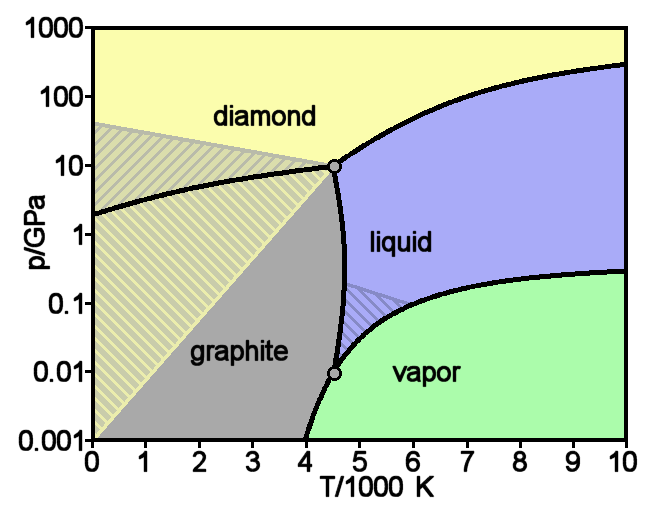
So recently I've been thinking a lot about diamonds, make of that what you will! Diamonds are a polymorph of carbon which basically means depending on the temperature or pressure carbon will take on different molecular structures.

This helpful diagram below will show you what I mean:

File:Carbon basic phase diagram.png

Diamonds come from deep within the Earth and are transported to the surface via Kimberlite pipes. Most diamonds are found either within these pipe-like structures or within sediments in rivers after the original rock has been eroded. Diamonds are the hardest material on the planet so are very resistant to erosion and transport (although a good whack on a diamond in the wrong place can shatter it!).

Diamonds come in a wide array of colours from white to black, yellow to blue and all the colours in between. Most people would probably be surprised to discover that a large amount of diamonds that are mined are not of gem quality at all and are used in industry as abrasives and in high-speed cutting tools.

Diamonds are valued based on the 4 C's, Colour, Clarity, Carat and Cut.

Diamonds are rated on their colour on a scale of D to Z, which D being the whitest and most pure colour and Z being a strong yellow colour. Both ends of the spectrum fetch high prices as a very good diamond with a strong yellow colour (known as fancy yellow) can be as prized as a white diamond, Tiffany yellow diamonds are world famous for their rich colours and high prices! Other famous coloured stones include the blue Hope diamond famed for the bad luck it gives its owner and the large pink diamond the Darya-ye Noor ('ocean of light') which is one of the largest cut diamonds in the world.

Tiffany Diamond2.jpg
The Tiffany yellow diamond was only warn by two people, the second was Audrey Hepburn in publicity shots for 'Breakfast at Tiffany's'

Like many minerals Diamonds contain inclusions which are small minerals that grew before the diamond and have been surrounded by it. In some gemstones, such as emerald, inclusions can add to the appearance of a stone as long as it doesn't compromise the structure, however the most highly prized diamonds are those free from inclusions. Many diamonds on the market are classed as having visible inclusions under a 10x hand lens but these inclusions will be invisible to the naked eye and won't effect the sparkle or 'fire' of the stone.

The weight of a diamond is a big deciding factor on the price of a stone although the combination of all 4 C's is taken into account when it is valued. Diamonds are weighed in carats which is a weight based on a carob bean. Because diamonds are dense materials a one carat diamond will naturally be smaller than one carat of a less dense mineral such a quartz. Large carat weights of diamonds are rare and rarely come on the market, many of which are in private collections such as the Koh-i-Noor (which means 'mountain of light' in Persian) which is in the crown Jewels of the British Royal family.

The cut of a diamond is the final important factor when valuing a diamond, and indeed before the cutting even occurs. There would be a temptation to maximise the amount of diamond used when cutting a rough stone but this can lead to a poorly cut stone of low worth. A good cut will reflect the maximum amount of light back out of the stone giving a good 'fire' and that well-known diamond sparkle. A poorly cut stone will not.
Preference of cut is a personal taste with the most popular being the brilliant cut, well known for its use in solitaire engagement rings. Other cuts include the Princess and Radiant cut which are two square shaped cuts, fancy brilliants which have similar arrangements of the facets with the overall shape being anything, although hearts are popular. Marques and Pear drop cuts are often seen on earrings (although the yellow diamond that recently sold at auction was a pear cut yellow diamond). Other, more specialised cuts are also used either to maximise material used or to hide flaws in the stone.
Perfectly symmetrically cut brilliant diamonds will display the 'hearts and arrows' phenomenon which requires high precision making such well cut stones extremely valuable.


Well, I hope you didn't mind indulging me a little bit of visual beauty this time. I hope you find diamonds as interesting as I do, they are truly one of the world's great wonders.


Diamonds are a girl's best friend but a boy needs to befriend his bank manager to buy one!

Monday, 28 November 2011

Google Auto Fill Once Again Proves People Are Weird... Geology Edition


OK folks, straight off I'll say it. I did not come up with this idea, noted American vlogbrothers John and Hank Green did and you can check them out here: http://www.youtube.com/vlogbrothers
Disclaimer out of the way, let's get started with some geology related google weirdness...

I asked google 'Is the Earth...' and google told me that people had asked the following:

"Is the Earth Round?"

Firstly, I would put to you that this is a question wrongly asked. In geology the opposite to 'round' is 'angular' what people may actually be asking when they ask this is 'is the earth spherical', the answer to which is, no not really. The Earth is by no means a perfect mathematical shape but the best approximation we have is a shape called an oblate spheroid, imagine a smartie or chocolate minstrel and you've got the right kind of idea although the Earth isn't actually that squished in the z-axis.

"Is the Earth bigger than the Sun?"

It's these kind of questions that make me wish that geology was more widely taught in schools but also that perhaps physics was too. Needless to say that the Earth is not bigger than the Sun in the same way that the Moon isn't bigger. We're closer to the Earth, that's why it seems bigger. I can only hope that it was a lot of 8 year olds doing school homework that bumped this question to second most frequently asked.

"Is the Earth flat?"

Most people don't realise that the Greeks actually calculated the circumference of the Earth. Pythagoras first proposed a spherical Earth in 6th Century BC and around 330 BC Aristotle accepted a model of a spherical Earth. The myth that historic figures believed the Earth was flat has partly been propagated by popular culture but despite satellite photographs of our planet as 'spherical' a 'flat Earth socity' still exists today. One can only assume that they have their own reasons for dismissing scientific proofs.

"Is the Earth hollow?"

OK, I have read bits from the top site that comes up after the wikipedia page and I'll leave you to read them yourself. Basically there's two theories about a hollow Earth, one is that the centre of the Earth is hollow and we live on the outside as we do now, the other is that we're all living inside the convex interior of the Earth with the Sun and the rest of creation suspended in the centre. At least that's how I'm interpreting it all, my mind can barely bend itself into being able to take in such ideas.

Here's the important thing to take away, we know what the structure of the inside of the Earth looks like thanks to geophysics. We know that there is a rigid lithosphere, a plasticine-like mantle that can flow, a liquid nickel-iron outer core and a solid nickel-iron inner core.

We also know how planets form by looking at meteorites which are basically tiny fragments of the original material that made the solar system. I encourage you to read up about because it's pretty amazing what you can learn about the Earth by looking at things that have collided into the surface of the planet.

So that's it, google auto-fill proving once again that the collective mind of the masses is just a little bit odd. No matter!

I'm sure when I'm board I'll do another one of these soon.


"Sedimentary my dear Watson!"